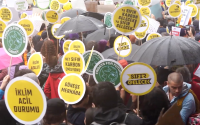
On Hüsnükabul, we go beyond surface-level events with Vijay Prashad and Waseem Ahmad Siddiqui to discuss the fundamental structures governing our world. Taking Walter Benjamin's concept of 'Now-Time' as a starting point, we tune in to a striking perspective that contrasts Europe's ordeal with fascism against the centuries-long suffering of the Global South.
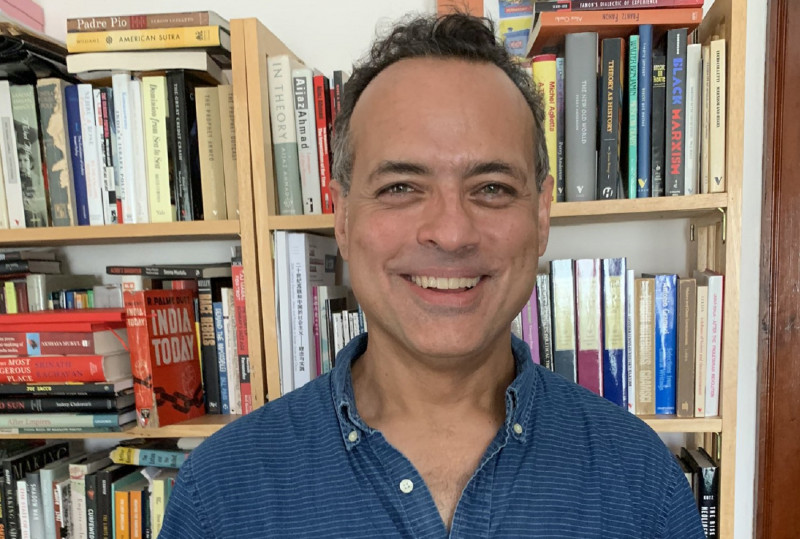
Waseem Ahmad Siddiqui: Hi Vijay, thank you for accepting my invitation and welcome to our radio program.
Vijay Prashad: Thanks a lot for having me.
Waseem Ahmad Siddiqui: Vijay the reason I invited you here today. There is ongoing complexity on articulation of what we are going through? That is to say, what are we witnessing? And what this present-moment where we all are in telling us? These questions are not new. But they do come to us in a time when things get overlap with one another and our eyes gets shatters. You may remember, the painting of Paul Klee: Angelus Novus. The German philosopher and thinker Walter Benjamin writes about it, by expressing his self on on the complexity of articulation and complexity of understanding present moment in his last essay: Theses on the Philosophy of History in 1940.
During the period when the German Nazis were committing genocide against the Jews, Walter Benjamin, like many others, wanted to escape the genocide but he couldn’t and committed suicide in Portbou, on the border between Spain and France. In that essay, Walter Benjamin, uses the German word “Jetztzeit.” The now-time or the present moment. The complexity of the present moment. Everything we are witnessing right now comes at us like a gust of wind. And the articulation has become very difficult.
My first question to you is about articulation. That is to say, how do you see and define the time we all are in? What words do you have when you look or hear to the injustices and brutality committed towards humanity, whether its Palestine( where more than 70,000 peoples killed in Gaza since Israel genocide began, October 7, 2023) whether its Iran, (where the large amount of protest are taking place and according to Iranian human right based platform in Norway, records 3000 peoples killed in recent protests)whether its Venezuela (where the abduction of Nicolas Maduro president occured), whether its America (where on January 7, 2026, Renée Good, a 37-year-old American citizen, was fatally shot in Minneapolis, Minnesota, by United States Immigration and Customs Enforcement (ICE) agent Jonathan Ross) whether its Turkey and Syria, especially as we are currently witnessing the tension in Syria. The Turkey plays a very important role historically in Syria. It has already been one year almost, Ahmed Alşarra temporay government. After Assad regime. There is a current ceasefire deal between Syrian Democratic Forces (SDF) and Syrian government. But what we witness at least in Turkey, the Kurdish minority in Rojava is going through oppression. We can count many other places like Ukrain, Germany India, Pakistan, Azerbaycan and many others.
May you help me understand, by giving your reflection on this very present moment we all are in? Was there a period in the past like this?
Vijay Prashad: Yeah, I mean, let's go back to Walter Benjamin's text, you know, just to start. I actually don't agree with the pessimism of that text. I don't agree with the concept of the now-time because in a way that's banal. We always live in the now-time, and the now-time is always an increasingly complicated. See, maybe there was a time when, when humans were not so interconnected. When we lived much more local lives as a consequence of different levels of technology. You know, your and my families probably knew each other a long time ago somewhere in Lahore. You know where my grandparents came from just outside Lahore, from an important Sikh community just outside Lahore. Maybe they knew each other. Who knows? Their radius of knowledge and travel was very narrow. They didn't travel like you to Turkey or like me to Chile. They lived where they lived. But now, or rather over the last 200 years, maybe even longer, since the time of the Columbus journey across the Atlantic, the world has become so completely interconnected. That complexity of knowledge, information, wisdom, different theories of the world, complexities of knowledge and complexities of events is overpowering. It has been like this and will continue to be like this. I mean, look, we live in 2026. Something happens in Iran, we know about it instantaneously.
This enters into the flood bank of our knowledge. Look at what you did. You recited a series of atrocities, one after the other. Now how do we understand this? Well, why should we? Why should you understand it? It's a chaos of information because there's just too much happening in the world for one person, you or me, to fathom. Some of it is not that necessary for us to understand what happened today in Azerbaijan. Do you know? Well, I don't know. Well, this happened. Well, okay. What does it matter to my life? There's an old story in an old novel which said, look, I'm eating a banana in my country, if I eat a banana and I'm told that five people die because I'm eating the banana, does it bother me? Well, I don't know those five people. So they are distant from me. And are they really being killed because I'm eating the banana. So there is a way in which we have become so interconnected and also violence has become so banal because of the interconnection. You know, there's just too much stuff happening. People can't absorb it. They say things like, I don't want to watch the news. I don't want to hear what's going on because it's overwhelming. Well, and that's because in a sense, events have overcome structures in our minds. We are stuck at the level of events. So when Benjamin writes, you know, we are in the now time, things are dense. He's talking about the rise of fascism.
Waseem Ahmad Siddiqui: Exactly.
Vijay Prashad: He's talking about mass death. But if I ever met, let's say we met in the Pyrenees. When he was thinking these thoughts, I would have said to him, listen, Walter Benjamin, you know, for hundreds of years out in the colonies, people have experienced what you call the now time, mass, mass displacements and killing of people. Yeah, I mean, what you are seeing happen in Germany, the attempted extinction of the European Jewish people that happened to people across the global south for a very long period of time. And we have to fight it. We can't collapse into the event. We have to fight it. But in order to fight it, we can't just fight it event by event, we have to also see what are the underlying structures. So that is what our Institute does. It is interested not merely in event by event, atrocity by atrocity, but by understanding the structure. So what is the structure at present? For decades, the United States and the Europeans, for decades they have dominated the world system. I'm saying for decades, I'm not saying for centuries, because there was a time when they were on the back foot. After the end of formal colonialism, Europe and the United States was a little bit on the back foot.
They had to deal with the fact that anti colonial movements were on the rise. They were pushing back against colonialism, against the imposition of new forms of colonialism. But since the fall of the Soviet Union, the West has really felt like it has dominated the world. And the West's domination of the world has come at an enormous cost. We call the Global south in some sense the sacrifice zone for the West's ambitions. You know, the west sacrificed the lives of people in the global south so people in the west could live luxurious lives. Well, unfortunately for the west, that time is ending and the Global south no longer wants to be the sacrifice zone. In that moment of turbulence, the west is trying to hold on as best as possible, using military force as much as possible, whether it's against the Palestinians in Gaza or the Iranians or the Venezuelans or the Chinese or the Russians or anybody, they will use any means. So this is a period of great violence, but it's not violence that is new to people in the global south. This is not worse than the period of formal colonialism. The massacres in Algeria, the massacres in Cameroon, and I'm talking about the mid 20th century.
The massacres in Brazil after the coup in 1964, 1 million Communists killed in Indonesia after the coup in 1965. This is not necessarily. This doesn't even come close to those numbers. One million communists and their supporters killed in Indonesia in 1965. Okay, this doesn't come close. So no, I reject Benjamin's idea that the present is atrocious and too difficult to understand. I'm a Marxist. I don't believe in utopianism like that or utopian despair. Because that text you're referring to on the philosophy of history is a text of utopian despair. You know, the angel of history is looking backward and seeing the ruin. I don't accept that. I don't accept that. Because people who've been poor for hundreds of years, they don't look back and say, look our lives were terrible. Then they say, look, now maybe our children can eat and learn to read and have a light bulb and we don't have to scratch the surface of the earth to bring out a potato. They don't look back and say, my God, it's a ruin. That's a European. Looking at European civilization and paralyzed, that doesn't reflect anything Waseem of our lives.
We don't look back and say, hey, there's the Mughal empire, we are crying for it. No, we are not crying for it. We are not crying for the British Empire. We are looking forward and saying, come the day when every child in Lahore, that city of my ancestors and that city of your family, come the day when every child in Lahore will be able to read, will be able to go to sleep at night without being hungry. We are looking forward, not backward. I reject that.
Waseem Ahmad Siddiqui: Yes. Well, Vijay, it is really very important response for me, regarding Walter Benjamin. And I can understand, or at least I can feel very strongly when you are rejecting. it's very important position which you are taking. And well, that was the first question which I was curious that what would you say? And it's interesting the way you have put a lot of things together. I Just want to come to another question of mine which I was actually thinking to talk with you with all these problem of thoughts which you have just said in the response of Walter Benjamin: Now time.
Now, I want to share with you something that I read recently.
Last week, the 80-year-old historian Alfred McCoy was interviewed by Amy Goodman on the Democracy Now!. The things he said during the interview were the things that have stayed with me. It was about the decline of empires.
He says, I quote:
“The United States is an empire in decline. And if you look back over the past hundred years, the lessons of history are pretty clear. Declining empires suffer from two things. One, they suffer from micro — what’s called micro-militarism abroad. They send troops abroad, in their flailing decline, thinking that some form of military intervention will recapture the global power that is slipping away from their hands. And then, domestically, the other thing they suffer from, every single declining empire over the past hundred years — the Soviet Empire, British Empire, the Spanish, all the rest — they suffer from coups.
So, as American politics become increasingly contorted and irrational, I think the thing to do is to realize that we are an empire in decline, and we are writhing in this kind of irrationality, particularly in the international realm. And it will continue for another decade or two, until the power, American power, finally slips away.”
That’s what Alfled McCoy, 80-year-old historian speak about the decline of Empire.
Now, it seems that in the spirit of our times (zeitgeist), the words like, collapse (decline) and irrationality (meaning lack of thinking (as Hannah Arendt says: thoughtlessness in her words) will appear more and more in front of us. So, in this regard, how can we understand today, the ideology of "empire" in decline by looking at America? The reason I am asking this question is, it is very clear that sooner or later America empire will fall. At least, that’s what Alfred McCoy says in his interview with Amy Goodman.
Vijay Prashad: So firstly, Alfred McCoy is a very important historian, wrote a book about the politics of heroin in Southeast Asia, which was a critique of how the United States during the Vietnam War was in the trade of drugs in order to finance at the time the war, the secret war in Southeast Asia. Later he wrote about how the United States was using cocaine to fund the Contras in Central America. It's very important to say that because this is exactly what Professor McCoy's work is on. And here was Venezuelan President Nicolas Maduro kidnapped while asleep on the charges of narco terrorism by a country documented narco terrorists, the United States. So, it's important to say that, because Professor McCoy's work is very important and very interesting. But on this case, I want to put it differently. Firstly, there was no Soviet Empire. I don't agree with that formulation. It was the Soviet Union. It was not an empire. They were republics within a union. But anyway, let's leave that aside. Separate discussion. But coming into this issue, you know, it's useful to look back at the collapse of the British Empire or the mutation of the British Empire. Useful to look at earlier forms.
But it's also misleading because when the British Empire was beginning its collapse, it collapsed as a consequence of the transformation of technology as well. Britain was not able, with its very small internal market, its very difficult situation with the first and Second World War, it was not able to advance its own technological role. And the United States really leapfrogged past the British in technology in this period, particularly during the period of the Second World War. And the technological things that the United States was able to do was it was able to build massive military capacity offshore. So that despite. And that's because the US Was far from the other battlefields. It had to put a lot of emphasis, like the Japanese did, on building aircraft carriers was important because you had to take your planes somewhere far away. So the technology of warfare, which the United States was able to not only not innovate, but to expand, was far greater than anything the British had. So whereas the British had a pretty circumspect empire, it was spread all over the world, but they didn't really have very good logistical lines, you know, between India and Britain. Let's say there was no easy way to get troops from one place to the other. Nobody did at that period but in the 1940s, United States developed incredible military technology.
And the base structure around the world was they took over British bases, such as in Diego Garcia, they took over British bases in the Caribbean and so on, and they expanded to 900 military bases. Today, to roll back US military power is not going to be easy. The British military power in the 1940s was both badly damaged by World War II, and it was just not technologically up there to be able to fight off any challenger. Today, the United States doesn't actually experience a challenger. There is no single challenger. It is experiencing a transformation of the world economy where its own economic power has declined greatly. But nobody can challenge its military power. Nobody. Look at the way Trump can talk to the Europeans. They're not going to challenge the U.S. forget it. Russia, China, these are powers that can defend themselves. They can't really challenge the United States. Look at the way the US Goes into a major country like Venezuela, kidnaps the President, takes him out. Yeah. I mean, look at our countries, Pakistan, India. When the US President says, they go, whoop. They don't want to challenge the United States. So this is not going to be the same scenario. This is not going to be something you can learn sufficiently from the collapse of the British Empire or any previous Dutch Empire. This is not comparable.
We need to actually look deeply into this conjuncture. What we see in this conjuncture, which is really very interesting, is that even despite the fact that the US has lost economic power, despite that fact, despite the fact that it no longer controls finance completely because it sanctioned the whole world, it doesn't really control raw materials. It can't control raw materials in different countries. It's having a hard time making sure that countries that sell oil are selling it and getting dollars in return. That's for the petrol dollar market. All of this is difficult. Nonetheless, President of the United States able to show up in Malaysia and tell Anwar Ibrahim, you got to do this. And Anwar Ibrahim says, I agree. He goes to South Korea, tells him, and they agree. He leaves. Anwar Ibrahim says, I'm very unhappy with what you did in Venezuela. If Trump arrived back in Kuala Lumpur tomorrow, Anwar Ibrahim would go, yes. Whatever you say, sir, I will do it. Why? Because everybody's terrified of United States military power, of its capacity to squeeze the small countries. And the Global south hasn't come together as a powerful enough and united enough presence. I mean, while, we're having this conversation, German Chancellor Merz says one of the great strengths of Europe is its unity. Really? Really. He says that's one of the strengths of Europe, Unity. I don't think so. I don't think there's any unity in Europe.
Yeah, I mean, you're lucky in Europe that there's the old European Community and all of that, but unity. Britain just walked out of the EU. The right wing in other countries are wondering, is this worth it? The last great European project was Airbus and maybe the European Space Program. What unity are you talking about? Unity to defend Ukraine. Are you crazy? That's hardly an indication of anything. Global south, there's no unity. Forget it. It doesn't exist. So we can't copy paste from history. Got to look in depth at the current conjuncture. Can't copy paste. And the reason we can't copy paste is that these are not cycles of history. This is not another empire falling. This is not the Roman Empire falling. History doesn't advance like that in circles. We don't go in circles. I don't see history in circles. I see history in spirals. But in the spiral there are also increases of technology and the productive forces. And things are different now. When, Rome was collapsing, they had to go across the Mediterranean in ships powered by rowing and powered by wind. Now our ships are powered by nuclear driven engines. They didn't know how to fly in a plane at the time of the Roman Empire. Now you can fly a plane, you can fly a helicopter that sits above a building in Caracas, Venezuela and grabs a leader. So technology and productive forces make a huge impact on the capacity of power to maintain itself.
Waseem Ahmad Siddiqui: Yes And it still makes me think about when Alfred McCoy says: “it very clear that the United States is an empire in decline”. I think it is something which is, which is going to at least make me think more in the future. Because what I see, and I think that can be my another question for you. For example, when we think empire as a God, empire as a spiritual God present everywhere, then one could object that empire is everywhere but on the other hand, one can object also the empire is nowhere.
Now, the constitution of nation-states in terms of its functions: the objective of imperial sovereignty is not the political-territorial inclusion or assimilation of subordinate countries and peoples, as was the case with imperialism and the colonialism of nation-states between the eighteenth and nineteenth centuries. Here, new and I want to underline here the new form of imperialism is exercised through political institutions whose objective is essentially the maintenance of global order – that is, a ʻstable and universalʼ peace that would allow the normal functioning of the market economy. Now I believe, this notion of peace is in the wrong hands. All empires believes including United Sates, military is a source which can brings peace.. What would you say about this emerging new imperial Powers which are “so called” exercising to bring peace in the world? And I think we have eight minutes left.
Vijay Prashad: Yeah, I'll be quick. I mean, look, firstly I'm not sure we are at a stage in history where they'll necessarily be a new imperial power. I think we are at a stage in world history where we're quite capable of demanding multilateral governance and not governance through one imperial power maintaining the so called rules based order which it has written. I think we've reached a stage of global maturity where the United nations charter could be our charter. And let me explain why very quickly, why this is so. Look, there was a time when the axiom of human civilization was might makes right. There was a time, in ancient India, if I was a prince, I got a horse and I spanked the horse on the back and sent it running. And where the horse stopped was the end of my kingdom. The Ashvamedha-Yajna. I would say that's the end of my kingdom. And if you say, no, this is my kingdom, then we have a war. And that's how we establish what is right. Now, you and I live in different kinds of societies where when two people disagree, they call the judicial authorities and say, look, my house goes to here, or my apartment has a door here. This person is claiming this room is theirs. And there's a way we can go through a legal process. Which is an adjudication process. So, as ordinary citizens of a republic, we have accepted that.
It's not about how many machine guns I have. I agree, there are some parts of the world where people still show up in Pajeros, you know, with their Madeira type gangsters. In Venezuela, they have Milandros. In Sindh, they have Maderas, whatever. Gangsters show up with guns. I know that happens. But you and I live in two different countries where if you have a problem with your neighbor, you go through an appellate body adjudication, some legal things, some insurance, whatever. We don't bring our knives out and go running after each other. So as normal people, billions of people around the world have accepted that we don't live under the axiom might is right. We just don't. We live under the axiom that there should be some rules and that decency is important. That if my neighbor is saying to me, look, don't use this footpath, it's my footpath. And I say, if I don't use this footpath, how do I get to the street? And the neighbor says, well, okay, I understand that, but I want you to realize this is my footpath. Yes, of course I'll sign an undertaking. This is yours, but can I please use it? Yes. You have right of way. And we can register that in a court that I have a right away, but I'm not claiming ownership over it. We have made an agreement.
So ordinary, billions of ordinary people Waseem have agreed that the principle of what is right or what is not correct. Billions of people. We are reaching a stage of human development, evolution, civilization, where we don't have to take out our pistols to confront problems. Two humans have a problem, two countries have a problem. You have to have an adjudication mechanism. You have to have a mechanism that deals with this and it has to be guaranteed by the other countries in the world, just as your and my dispute is guaranteed by the other citizens in the country. They guarantee that our agreement is going to be respected. So in that sense, I don't think you need to imagine that your right is forever. Because if you do that, you both negate the actual fact of human progress, which happen because we don't walk around with guns. I don't carry a gun everywhere, as our ancestors probably carried a knife or a sword or something. We don't carry guns everywhere. We carry a mobile phone. And at the same time, we have an international charter, the UN charter. It's a very good document.
So, I believe, I'm an enormous optimist about the capacity of humans to improve the way we deal with each other. And so I would say let's not imagine that there always needs to be an empire. Imagine a post imperial planet. Because we don't need an empire. You know, we need regional agreements. We need the UN to be taken more seriously. We don't need a “Dada”, “Boss” or this or that. We just don't need it. We don't need it. It doesn't help. It doesn't help. We need to come to agreements. India and Pakistan need to find an agreement. For instance. What's happening in northern Syria? Turkey needs to come to an agreement with the people who live there. End of the day, you agree to things you begin to understand. You have to treat people decently. That's how all conflicts in our period have to end. We want to establish decency in the world, not power.
Waseem Ahmad Siddiqui: Vijay, as we only have two minutes left, perhaps my very last question to you. It might seem little difficult, but I want to ask you what do you think about the institutional and normative forms of what which one can call counter empire, that is of the alternative political organization of struggle. What would you think about this alternative way of struggling at this very point?
Vijay Prashad: Yeah. I mean, I believe that struggles have to be captured into organizations in order for us to build not just counter empire, but different forms of political power that, you know, the example of all our countries is the same. You know, you can have massive mobilizations of hundreds of thousands of people on the street, but the next day, nobody goes to Gezi park or nobody goes to, to Tahir Square, it's all over. Yeah. And then, oh, what's his name? Oh, you know, it's not Mubarak. He's gone. Oh, it's Sisi. But Sisi looks like Mubarak. It's all the same. So, the point is that it, it doesn't work just by having counter struggles. You need to build something. You need to build a house. A house for the people.
Waseem Ahmad Siddiqui: Exactly. That's what is very, very much empowering. Vijay Parishad, I'm very happy to have you and thank you so much to join me. I hope that we can continue talking it, next week, next month.
Vijay Prashad: Yes sure. Take care of yourself.